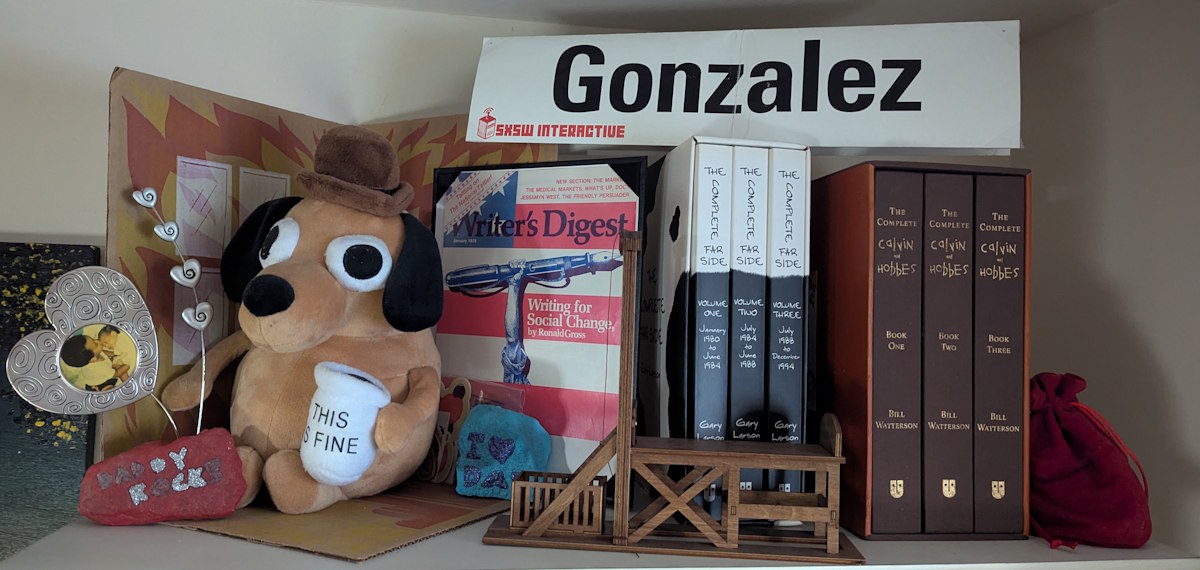
NOTE: 2026 is kicking my ass left, right, and sideways, and instead of doomscrolling, I’ve been buried in a big day job project and pretending OOTP26 is a legit side gig, all while trying to survive my least favorite season. Instead of feeling defeated and skipping the newsletter outright, these “five things” are from the “I was made for the library…” wing of the archives.
_ONE
The Future of the Book Might be in Librarians’ Hands | Me, 2010
“Librarianship doesn’t change because of technology,” declared Shaughnessy. “It’s still about connecting people with information and each other.”
This article was my first assignment for Publishers Weekly, covering the first (and only?) Empire State Book Festival in Albany, NY just a few months after Digital Book World had launched. I’m 99% positive my now-friend Andrew Albanese tapped me for it, as he did again ten years later for what remains one of the best (and most fun to research) articles I’ve ever written: “How the Award-Winning Nashville Public Library Makes the City Tick”
In the Spring of 2010, libraries were just hitting my professional radar thanks to DBW, mostly related to the challenges they were facing getting access to ebooks at all. One of the panels I covered was moderated by Marilyn Johnson, named for her excellent book, This Book Is Overdue. Less than a year later, that book would heavily influence my decision to go work for LJ/SLJ, a sliding doors moment that effectively redefined my career trajectory for the next fifteen years — and still counting.
I’d forgotten that I also attended a comics panel that day, which basically means the festival was a foreshadowing moment for a future I never would have imagined possible at that point!
__TWO
Why It’s Time to Quantify the Library’s Role in the Reading Marketplace | Me, 2019
It’s rare to see a vendor so publicly challenge a key partner. But the belief that library availability cannibalizes consumer book sales is a persistent, unproven conclusion with no public data to support it. And the underlying premise that library patrons borrow books or e-books they would otherwise purchase suggests a fundamental misunderstanding about the various ways patrons use libraries today.
I worked for LJ/SLJ from 2011 – 2015, a period when Twitter had unfortunately supplanted my own blog as my primary platform, and most of my “editorial” energy was directed towards supporting our various efforts there, while also being a little more careful about sharing my industry opinions elsewhere. There are several of my own posts I could have linked to here, but most don’t have enough context to stand alone; the libraries tag is there to explore if you’re thirsty for tea and want to dig deeper. You do you.
This article, again for PW, was written while I was running the Panorama Project (RIP). It was partly a stealth preview of our plans for 2020 (before COVID disrupted everything, everywhere, all at once), and partly a call-to-action for industry players to stop ignoring and/or shitting on libraries.
Six years year later, I could be a normal blogger and republish that article with a few minor edits, and it would still stand up. Even better, you can just go read it now and ignore the publication date. One thing that did change, less than a year later, was I ended up helping launch a company that sought to be the change, and I’d say we’ve done a pretty damn good job making progress with it.
___THREE
Where Do Libraries Fit In “A Viable Consumer Marketplace”? | Me, 2019
While it’s quite possible some books’ retail sales are being affected by library lending as readers decide they’d rather wait to borrow the latest bestselling ebook from the library than license it immediately for $14.99 from Amazon, it’s also quite possible—perhaps even more likely—other factors are at play, like competition from other publishers and self-published authors’ ebooks, or the rarely correlated rise of audiobooks—a format dominated even more by Amazon than ebooks.
The first DBW in 2010 had a huge impact on how I thought (and still think) about the book publishing industry, and this one was a callback to one of its most controversial presentations, focusing on one of the major boogeymen of the moment: piracy. Most of that presentation was fundamentally flawed, rooted in a myopic misunderstanding of who pirates content and why, but the desire to create “a viable consumer marketplace” stuck with me.
This article was kind of a personal follow-up to the PW op-ed above, driven by the persistent but unproven belief that library lending of ebooks was cannibalizing consumer sales — a belief that continues to harm libraries and readers to the present day.
____FOUR
On library ebook licenses, patron demand, and power dynamics | Me, 2024
Meanwhile, libraries have generally proven reluctant to use their power to shape the demand curve and shift digital budgets away from expensive Big 5 bestsellers, even when it means sacrificing diversity and depth in their own digital collections.
I’ve never been afraid to call publishers out for their mistreatment of libraries, but I’m usually more reserved in my criticism of the decisions libraries have made that make it easier to be misunderstood and mistreated. Sometimes, the killer’s accomplice is in the house.
In this case, a spark was lit at a conference I attended in late 2024, and it’s the most specific thing I’ve ever written about how libraries could, and should, help themselves solve the challenges of predatory ebook licensing. There’s one simple trick…
_____FIVE
What is a “Library-Friendly” Publisher? | Me, 2025
While most publishers love what libraries represent, ebook licensing is a little more complicated.
Most of my writing at the day job has either been anonymous or press releases, but every now and then I’ve written something there that would fit just as easily on my own blog, or as an op-ed for PW.
“Library-friendly publisher” is a term I started using early on in our marketing copy to shine a positive spotlight on publishers who were supporting equitable access to ebooks via nontraditional (aka, affordable) licensing models, and where there’s light, there’s also shade. IYKYK.
______BONUS
“I was made for the library, not the classroom. The classroom was a jail of other people’s interests. The library was open, unending, free.” Ta-Nehisi Coates, Between the World and Me
Do you like email?
Sign up here to get my bi-weekly "newsletter" and/or receive every new blog post delivered right to your inbox. (Burner emails are fine. I get it!)

(this is a LIKE–I cannot see the button anywhere)
That was a Jetpack feature, so it’s gone now, but I appreciate it even more as a comment! 🙂
😉