NOTE: I’m still taking on short-term projects while continuing to explore my next long-term move, and have added a new block of time to my calendar for consultations in August. If you’re looking for help with Strategic Planning, Content Strategy, Audience Development, Email Acquisition & Engagement, Event Programming, and/or Project Management — let’s talk.
_ONE
One Year After Connecticut’s eBook Law | The Straight Download
That is an essential title within a library’s collection that they should have. We don’t have that because we’re chasing the holds list, because we are buying the holds list. It is limiting our ability to build broad and deep collections. And that is the essential role of the library. We are not just here for the James Patterson titles.
I caught most of this episode live at ALA last month and nearly hollered “Amen!” several times as Ellen Paul broke down various aspects of library ebook pricing, the limitations of legislation, and the power libraries already have to take control over their digital collections and influence the demand curve. I’ve been on that soapbox for years, but it’s encouraging to see more librarians speaking out publicly and challenging the dominant narrative that casts libraries as powerless victims of the Big 5.
Librarians are caught between the proverbial rock and a hard place — wanting to give their most active patrons what they want to read, while also wanting to build diverse collections that serve less active patrons, too — but if they can find the “bravery” to publicly eliminate access to Hoopla, surely they can also communicate to patrons that some of them will have to wait a little longer to read the latest bestsellers so they can afford to offer access to a wider range of ebooks?
The whole episode is worth listening to, with kudos to Ann Ford and Jeff Jankowski for making the space and advancing a tough but important conversation. Other library vendors should take notes, too, because librarians need all of the support they can get right now.
NOTE: I’m working on a follow-up for Words & Money related to this, so stay tuned for more soon.
__TWO
More Flexibility Is Making Us Less Connected | David Epstein
Flash forward several decades, and streaming ended the shared TV night. Delivery apps ended the shared meal hour. Remote work made the nine-to-five a polite suggestion. Gig platforms turned weekends into peak earning shifts. Each change was a genuine individual convenience. Cumulatively, they built a quieter nepreryvka—one nobody decided on, and one we seemingly have no plan to end.
I’ve been officially WFH for seven years now (before the pandemic made it more common), and although I appreciate the flexibility it’s enabled, I’m also fully aware of how disconnected I’ve become with each passing year. I haven’t had a “home office” since 2019, and by the end of 2022, most of my close professional network had left the NYC area to take advantage of remote work and lower costs of living elsewhere.
After six years of remote work with LibraryPass (while retaining the higher costs of living!), I still hadn’t met the majority of my now-former colleagues in person, significantly reducing the chances that we’ll stay connected beyond an occasional LinkedIn emoji or brief encounter at ALA. But — I also made a few deep connections that were developed and nurtured in virtual meetings, Slack conversations, and a few intense tests of “mission & vision alignment” in the trenches.
Blanket RTO mandates are stupid, full stop, but I genuinely miss the personal connections that were nurtured by face-to-face interactions, spontaneous lunches or after-work drinks, and the subtly palpable disdain for a mutual enemy during a contentious meeting. That’s extremely difficult to replicate on video calls, but none of that requires being in an office 5 days/week, either.
Hybrid scenarios with maximum flexibility are the way to go for most typical corporate situations, and fully remote options should include (and fully budget for) an occasional in-person convening, whether at a home office or major industry event.
Related: No more binge releases! The World Cup was fun. Let’s watch things together again on predictable schedules!
___THREE
Rereading V for Vendetta in the Age of Surveillance | Matt Alley
If there’s one lesson I took away from researching these stories, it’s that freedom usually isn’t destroyed in a single dramatic moment. More often, it is diminished gradually. One exception. One emergency. One new technology. One additional database. One more camera. One more collection of data that seems harmless on its own until someone finally steps back and realizes the entire landscape has changed.
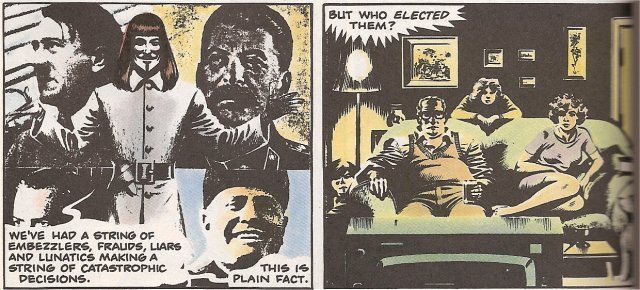
V for Vendetta is one of my all-time favorite comics, and my combined review of it and the movie adaptation is one of my all-time favorite essays — so I’ll never miss an opportunity to shout it out. I’ve wanted to revisit both in recent years, for obvious reasons, and Alley’s take digs into some of the reasons why it remains relevant forty years later.
It also pairs well with Epstein’s observation (above) that we didn’t consciously choose “a quieter nepreryvka“, but it’s where we’ve ended up anyway.
____FOUR
Does Soccer Still Explain the World? | Alex Shephard
Published a year after the start of the Iraq War, Foer’s rosy look at globalization was already passé as the U.S. took on a more aggressive, hostile, and xenophobic posture to the rest of the world. It arrived at a pivotal moment in the rise of U.S. soccer but also one for the economic trends he describes. It was still possible to be hopeful, albeit faintly so, about globalization in 2004. In 2026, it looks considerably different.
By the time the Men’s World Cup in 2014 ended, I was hooked and went all in on soccer after completely ignoring the sport my entire life! As with any new interest, I dove deep and devoured everything I could find, and Franklin Foer’s How Soccer Explains the World: An Unlikely Theory of Globalization was the first book I read.
I went on to read a lot more books about soccer — including Soccer in Sun and Shadow by Eduardo Galeano (translated by Mark Fried); Futebol Nation: The Story of Brazil Through Soccer by David Goldblatt; When Friday Comes: Football, War and Revolution in the Middle East by James Montague; and Fear and Loathing in La Liga: Barcelona Vs Real Madrid by Sid Lowe, all of which were more influential in my evolution as a global soccer fan — but Foer established an excellent foundation to build upon, particularly for the non-European stories. It was an eye-opening survey of the (not always) beautiful game back then, and while I didn’t grasp the full context Shephard critiques here when I first read it, I do recall sensing some of the gaps.
I’m not a fan of new editions that only add an updated foreword, but read with Shephard’s commentary fresh in mind, it’s probably still a solid entry point for understanding soccer football at an international scale, especially if you’re newly hooked by the latest World Cup, and especially if you felt deceived by the hype surrounding the US Men’s team!
The 2026 World Cup was arguably perfect timing for a sequel, ideally as an anthology written by contributors from different parts of the world reflecting on how much has changed since Foer’s original book, but with the Women’s World Cup a year away, there’s still time for a savvy publisher to seize that opportunity. Shephard would be a great editor for it, too.
_____FIVE
How Spain built a soccer identity that conquered the world | Tales Azzoni
Spain is the first nation to hold both the men’s and women’s World Cup titles at the same time and is the only country with two men’s World Cup triumphs this century. The nation also has won several youth tournaments in recent years with both the men’s and women’s teams.
I can’t remember exactly when La Liga became my primary international league, but it definitely started with a 2016 family vacation to Santander where I randomly caught a preseason game for Racing Santander, who were in the third division at the time. We’d spent a few days in Barcelona prior to that and caught a game at the Camp Nou, but I was still primarily watching MLS and the Premier League, enjoying the lingering high from Leicester City’s improbable championship run from worst to first a few months earlier.
I was definitely all in by 2017 when I started following Real Betis, who became my La Liga team that year, which will become more complicated this coming season now that Santander have been promoted. After 10 years of being immersed in Spanish football, I was fully aware that Spain was one of the frontrunners for the World Cup, so I was surprised when Landon Donovan suggested they were under the radar, and that they might be worried about facing the US team in an upcoming round?!?
Spain — the reigning European champions — being “under the radar” was repeated by another commentator during their game against France (after the US had been exposed by Belgium and bounced from the tournament once the brackets stopped favoring the hosts), so it was apparently a thing informed professionals weren’t embarrassed to say out loud, which suggests too much attention was being given to the biggest stars and not enough on the complete teams and the depth Spain, in particular, brought to the competition.
The best team, playing the best team game like a team, won the biggest team game in the world. As it should be. And the scariest thing for everyone else is most of that team will be back in four years, and probably be even better!
PS: Spain’s women are also very good, so keep an eye on their upcoming friendlies against the US. Unlike the US men’s team, the US women are the ones other teams actually worry about, which is why they have four stars on their jerseys and the now equally paid men still have none.
______BONUS
Do you like email?
Sign up here to get my bi-weekly "newsletter" and/or receive every new blog post delivered right to your inbox. (Burner emails are fine. I get it!)