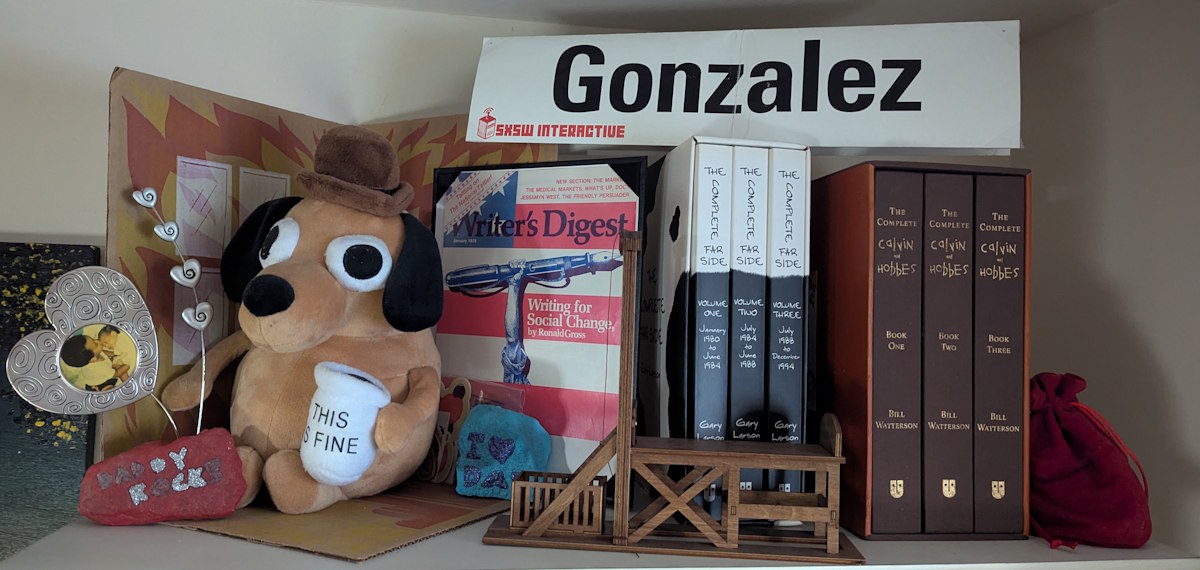
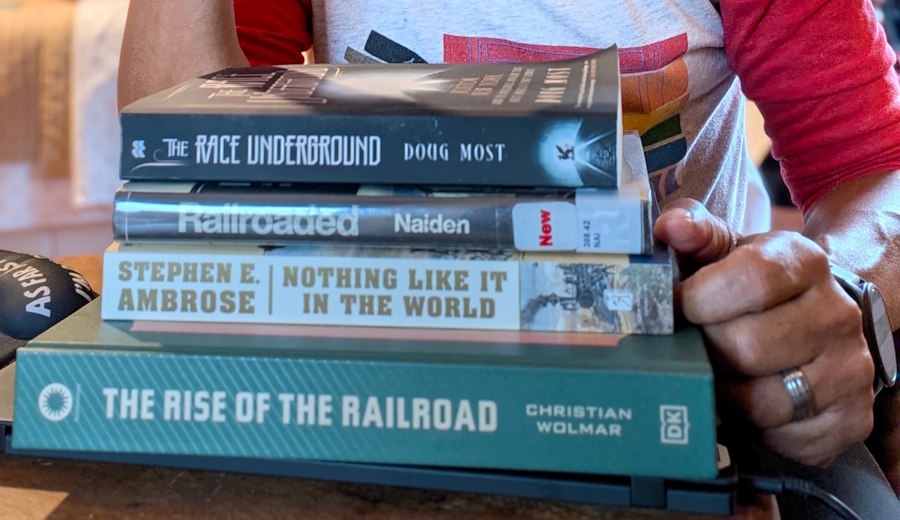
NOTE: Things are finally starting to stabilize after a chaotic summer bled into September, which ended on a high note with good news on a couple of fronts, including a new gig! More on that another time, but there’s a little hint in the Bonus section.
_ONE
In the Library Ebook Market, Can Librarians Learn to Just Say No? | Me!
But if the recent tension over library ebook legislation has shown librarians anything, it is this: the major publishers have the power to dictate terms for licensing their content, but maintaining the status quo in the digital library market is ultimately a choice being made by librarians. And the reality is that libraries have other choices.
I’ve been involved in the Library Ebook Wars for way too long, but I’m hoping the AAP/Authors Guild Summer of Misinformation was the tipping point for public libraries to finally realize they’re not powerless victims. The Big 5 have shown their cards, threatening to pull out of the library ebook market completely rather than pull up to the negotiating table in good faith.
It’s time for librarians to call their bluff.
After 15+ years of advocating for libraries in a variety of ways, some of which probably harmed my career at times, this was an extremely cathartic article (manifesto?) to write. I appreciate everyone who spoke candidly and on the record with me, and am thankful to Andrew Albanese (aka, Albanese Intelligence!) for helping refine it and lending me his platform to get it out there.
There are several people and organizations doing great, consistent work advocating for libraries who should already be on your radar — including Andrew’s Words & Money, Kelly Jensen, Library Futures, and (despite their refusal to use alt text on social posts) EveryLibrary — and I’ll continue to amplify their efforts, but this article is the last two dollars I’ll publicly add to the conversation for a while.
I’m taking a break to just be an active patron at my own local library.
__TWO
Personal Data Silos | Dominic Wellington
But even in the enterprise world, one of the stumbling blocks for automation that goes beyond the scope of a single department is disconnected silos of data that are owned by different teams with different goals. The rise of Software-as-a-Service (SaaS) delivered via the cloud means that different providers may also try to insert themselves in that conversation…
Wellington is mainly writing about how we as consumers not only don’t own our digital content, we also don’t own the data related to that content, making truly useful “AI” butlers a pipe dream. This particular comment gets at something I’ve argued for years, though, even before the “AI” brain worms took over.
Proprietary data silos have been one of the primary impediments to the book publishing supply chain making any real progress on improving discovery, marketing, and sales for many years. There’s even an entire organization dedicated to solving that kind of problem, albeit with extremely limited success. (Standards are meaningless if they’re not consistently embraced, or only implemented when it benefits specific participants in the supply chain.)
The idea that publishers might “provide information in a less structured way to retail partners in a way AI could consume it” — as publicly suggested by one major publisher recently on an industry stage — would be laughable if it wasn’t so depressingly wrongheaded.
Publishers’ real “AI reckoning” isn’t “use it or die”, it’s “use it blindly because FOMO and lose another 10 years of progress on tangible opportunities.”
___THREE
Will We Ever Solve the Problem of Losing Data? | Gayoung Lee
I know of one data storage form that can be permanent: a library. Or rather, a world full of libraries. Libraries aren’t perfect storage devices (nothing is), but they are fiercely committed to self-repair. A good library is a collection of people, technologies, and practices that pass an obligation—to remember the things we must remember—from the last generation to the next. (Jack Cushman)
Despite the outrage over Sony moving away from physical releases in the near future, video games have been primarily digital for several years already, and Xbox doesn’t get enough credit for investing in backwards compatibility to make previous generations of games playable on modern devices. It’s not the same as pulling out your original Xbox and a physical copy of Halo, but I suspect there’s plenty of data to show most gamers (console and PC) have already moved to digital for most of their games.
I haven’t bought a physical game in several years, but I do still have a working Atari 2600 and a handful of original game cartridges — which I haven’t dusted off and plugged in years, but I’m currently on the hunt for a reasonably priced, working CRT TV to make it easier.
After a few years of rebuilding a small vinyl collection, I decided to focus on CDs again, since I had a drawer full of them that survived my “everything’s digital now!” purge 20 years ago. In both cases, I also had to buy new equipment: a record player, and a CD player. Thankfully, there’s still a market for both. Interestingly, old vinyl still plays well, and you can usually clearly see the scratches that make the difference between an annoying skip and an unplayable record. Bad CDs are less obvious, and I’ve slowly discovered a couple of dozen seemingly unblemished ones that are actually unplayable.
Earlier this year, just as I was ready to start diving deeper into Warhammer 40k novels, Games Workshop proved that the Big 5 aren’t the only problematic publishers, making the unfortunate decision to stop selling DRM-free ebooks direct from their website, forcing people to use their proprietary half-baked app instead, or “buy” them from Amazon and Kobo. I still have the handful of ebooks I bought from them before the switch, but the chances of me ever “buying” another one of their ebooks is next to zero. I also wouldn’t think to request my library get a copy just for me — but maybe that’s what I’m supposed to do? I wonder what their ebook licensing terms are? I wonder how much of a bigger problem piracy will be for them now?
Anyway, Lee rounds up a broad range of interesting perspectives on the challenges of data preservation in the digital age, and while libraries are one of the answers (as they often are for too many things), the other options are intriguing, too.
____FOUR
Why becoming a LinkedIn lunatic might save your career | Amanda Hoover
LinkedIn obviously wants people to post more and comment more, but is cautious about AI dragging down the quality. The company removed the “enhance your post” AI writing feature in July and added a button that allows users to flag a post that “seems like AI slop.” Since then, the slop emergency button has appropriately flagged AI slop 94% of the time, and the views on such content have dropped by 40%…
LinkedIn became one of the primary platforms in my post-Twitter personal learning network, but it takes some aggressive curation of my feed to make it useful. Not all connections need to be followed, and not all follows need to be connections, and that approach means I thankfully haven’t had to use the “seems like AI slop” flag yet.
If you follow me there AND read these newsletters, you’ll notice a lot of overlap as many of my posts there are first drafts of what ends up here, part of my own personal data preservation policy to not lose things I’ve written when other platforms go away. (RIP Buzzscope. RIP DBW. RIP Twitter. RIP Panorama Project. RIP LibraryPass…?)
I’m actually cancelling my own Premium account (again), because I didn’t see any value in it. The job listings and recommendations are practically useless, and I don’t use the AI features that allegedly help you game the system. The LinkedIn Learning courses I checked out were on par with or a step below most free webinars and blog posts on similar topics, while seeing who’s looking at my profile usually raises more questions than it answers, so where was the value coming from?
I do think there’s still value in being present and authentic for anyone in industries that are well represented there, though, arguably more than any other major social platform. As Hoover correctly notes, you never know who’s keeping an eye on you, or will serendipitously come across a post (or insightful comment) of yours at the right time.
It might even lead to an interesting and challenging job offer you wouldn’t have found otherwise!
_____FIVE
How to usher in an era of abundant vengeance | Mike Monteiro
Some of our “design leaders” apparently never ordered the Sea Monkeys when they were kids, so they’re learning the lesson now. Except that instead of a $1, a fishbowl, and 6–8 weeks of waiting time, our design leaders need all the world’s water, all the world’s computational power, the exploitation of workers in the Global South, half the world’s land for data centers, and the disappearance of all the actual people who were doing the actual work. In return, they will deliver a machine that may or may not keep telling teenagers to kill themselves, and decide which girls’ schools to bomb.
Yes, it’s another AI rant — one of the best I’ve read in a while — and Monteiro thankfully writes with anger, but his conclusion is also written with fierce hope and optimism.
______BONUS
Do you like email?
Sign up here to get my bi-weekly "newsletter" and/or receive every new blog post delivered right to your inbox. (Burner emails are fine. I get it!)
::trying and failing to figure out the new gig::
I give up and just wish you the literal possible best.
Thank you! I’m not being vague for kicks, just want the formal process to play out before I say anything specific. It’s definitely not an obvious move nor one I saw coming, but it’s an exciting one!
I completely understand–I’m keeping my fingers crossed all the way through the last dotted ‘i’ and crossed ‘t’.