Is the Future of Publishing…GOOD?

Don't Believe Everything You ReadThe bad news in the publishing industry didn’t let up last week as reports of cutbacks and layoffs and dramatically decreased revenues continued to pour in, and TheMediaIsDying tweeted every depressing bit of it, from major publications to small local radio stations, the rare bit of positive news they offered up paling in comparison.

One tweet in particular caught my eye because the issue in question had just arrived in the mail, one of several unsolicited “trial subscriptions” that have come my way recently, presumably to shore up increasingly problematic rate bases for ad-supported magazines:

themediaisdying The February WIRED is only 113 pages, of which only 31.5 are ad pages, per alleyinsider.com – not the usual 1:1 ratio. (@woodenhorsepub) 10:55 AM Jan 23rd from TweetDeck

Interestingly, there’s a letter to the editor in that issue that tweaks Wired about the amount of advertising they usually run, with a surprisingly defensive (and five times as long) reply that concludes with: “P.S.: Advertisers, please do not read this note.”

About an hour before that depressing tweet, GOOD magazine’s blog ran an interesting, if somewhat self-serving post, “Don’t Be (Quite As) Evil“, that posed the question, more or less, What if companies stopped advertising completely and, instead, put that money towards doing good things and getting PR for it?

These are scary days if you’re in the ad business, and not because the economy has bolted out from under us and off into a canyon. No, it’s scary because on the other side, there’s more terror still, because even when consumers begin to buy again, it’ll be harder to reach them. They don’t buy print media; they skip past television ads using their DVRs; they ignore pop-ups and banner ads online. And even if they’ve noticed your ads and go shopping for your gizmo, your $300 million ad-spend might be undone by a single, anonymous reviewer on Amazon: “This product sucks.”

Against that background of flailing ad effectiveness, companies are shifting their ad budgets, one tiny step at a time, towards meaningful P.R., dedicated to noble causes. But what’s stopping a massive company from working at a grander scale, to really do something?

The unavoidable answer: It’s because of you. It’s because you’re too uninformed, too indifferent, and too cynical. I’ll explain. Consumers haven’t quite yet proven that they put money where they’re morals are—or that they’re willing to spend the time and effort to figure out what’s moral to begin with. Too often, cynicism yields to blanket indictments of “corporate America,” which leaves businesses with few incentives to try harder. What really prevents big companies from investing more is the nagging fear that you, the consumer, won’t notice. Or what’s worse, that even if you do, you’ll never reward them for it.

Despite being marred by a gross over-simplification of how advertising works and an unfortunate “blame the reader” angle, it’s worth reading as its underlying premise is sound: companies should do good things and tell people about their efforts.

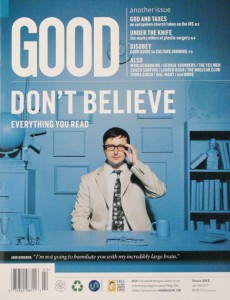
In the context of advertising vs. PR, though, and the currently precarious state of publishing, as the cover of their second issue (above) noted: “Don’t Believe Everything You Read”.

(more…)
Continue ReadingIs the Future of Publishing…GOOD?

Twitter Tips for Writers

I raved about my former Writer’s Digest colleague, Maria Schneider, a couple of weeks back — towards the end of a long rambling post that no one but my wife probably read — because she’s put together one of the best websites for writers out there at editorunleashed.com.

She’s not only producing some great content including tips on writing and getting published and links to great free resources, she’s interviewing writers and agents, hosting a vibrant and active community, and has even started offering workshops on everything from writing an effective query letter to intensive fiction workshops designed to help you finish that novel.

Her post today about Twitter was particularly timely as I’ve started using it a lot lately, both personally and professionally, but I’m not sold yet on its real value. I’m still in the early stage of what she likens to “being at a cocktail party where you know no one”, but her tips on how writers can get the most out of it and 25 Twitterers to follow is a great resource:

There’s a bunch of publishing types using Twitter and following them is tapping into the zeitgeist—a never-ending stream of conversations, random thoughts and links. It gives you access to lots of smart, interesting, connected people.

But if you’re just getting started on Twitter it can be really intimidating, so I’ve made this list of 25 good follows for writers composed of the twitterati, book bloggers, agents, publishers and writers. This is by no means an exhaustive list of twitterati, but it may be a good start for you. Check out who these folks follow to find many more.

There are several people on her list I wasn’t following whom I added, including Bo Sacks (who surprisingly only has 83 followers?!?!) and Ron Hogan, and I was glad to see my old publisher Soft Skull there, as Richard Nash has a very high signal:noise ratio (something many Twitterers, myself included, haven’t quite figured out yet).

I’ll add to her tips that you can also do a version of Google Alerts on Twitter Search, and get an RSS feed for any topic of interest being discussed on Twitter.

(more…)

Continue ReadingTwitter Tips for Writers

Is Print Advertising Dead?

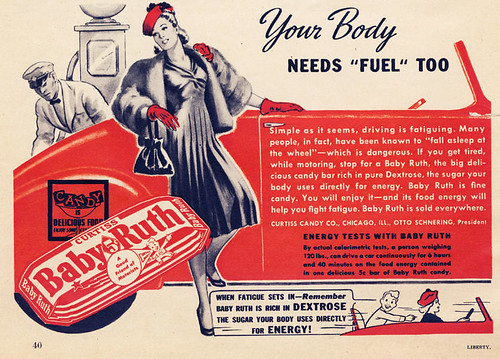
Vintage Baby Ruth Ad by dklimke

Check out @themediaisdying on Twitter for a glimpse at the convulsions of an industry that’s either at death’s door or, for the more optimistically inclined, in the midst of a violent but necessary transformation.

I’ve worked in magazine publishing for 15 years now — consumer, B2B and non-profit — and as has been noted pretty much everywhere recently, 2008 was an ugly year.  Mass consumer and B2B brands are getting hit the hardest, but even local and niche brands with strong subscriber bases are getting hammered by this perfect storm, and surprisingly to almost no one with any sense some people, the Internet has turned out to not be the magic bullet it was proclaimed to be.

(In fact, in many cases, online publishing is effectively “trading dollars for pennies“, and the economic fallout that’s affected print advertising is undoubtedly going to affect online advertising, too. ETA: It already has.)

Flip through the most recent issues of your favorite magazines and you’ll probably notice they’re a little bit lighter than they used to be. Less editorial content; thinner paper; deeply discounted, sometimes desperately worded subscription offers.

Almost all of them likely have less ads (and in many cases less relevant ads) than they used to, too.

I was cautiously optimistic that the major damage might be limited to 2008, and 2009 could be a rebuilding year for most brands on flat revenues, with some going under and a few even pulling off a Miami Dolphins-style turnaround, but 13 days into the new year, it looks like things still haven’t quite hit bottom.

(more…)

Continue ReadingIs Print Advertising Dead?

Goodbye Borders, Hello Kindle?

Things are looking shakier by the day for Borders, with GalleyCat now reporting that a Major Distributor Raises Concerns about their financial situation:

GalleyCat has received a copy of a “special alert” sent from a major book distributor specializing in independent publishers to its clients, warning them that Borders, whose financial difficulties are widely recognized, “now tell us that they will not be paying us for two months due to anticipated excessive returns,” a situation the company views with understandable concern. This distributor “typically carries receivables of approximately two million dollars with Borders,” the memo continues. “A default of that amount would by no means put [us] out of business, but it would be painful, weaken the short-term health of the company, and would mean we would have to defer some of our plans for future growth.”

This on top of Barnes & Noble announcing their expectations for a brutal holiday season and no sign of things getting better any time soon:

The chairman of Barnes & Noble Inc. last week told employees via an internal memo that the nation’s largest bookstore retailer is “bracing for a terrible holiday season,” and that he expects “the trend to continue well into 2009, and perhaps beyond.”

In his memo, Leonard Riggio, the retailer’s largest shareholder, noted that comparable store sales, a key retail indicator, recently declined for the first time in the retailer’s history.

“Never in all of the years I’ve been in business have I seen a worse outlook for the economy,” wrote Mr. Riggio. “And never in all my years as a bookseller have I seen a retail climate as poor as the one we are in. Nothing even close.”

So, if the two biggest brick-and-mortar book retailers in the country are having such a rough time of it, perhaps Amazon.com is picking up the slack and the future of bookselling lies online and the printed book slowly gives way to the Kindle and iPhone?

(more…)

Continue ReadingGoodbye Borders, Hello Kindle?

Why Your Book Will Never Be in Borders

The odds are pretty slim, and not just because they’re on the verge of going out of business:

“I market books for a living, so I can tell you an unpleasant truth: the order for any book, from any account, starts at zero,” [Andrew Wheeler, a marketing manager at Wiley] warns. “The publisher’s sales rep walks in the door with tipsheets and covers, past sales figures and promotional plans, to convince that bookseller’s buyer to buy that book… Sometimes, that buyer is not convinced, and the order stays at zero.”

(h/t GalleyCat)

The distribution system in publishing is arguably broken, partly a result of the industry’s major players’ short-term thinking, and partly because the overwhelming number of books being published these days is more than the system can support.

(Writer’s Digest publishes an aptly titled book: Some Writers Deserve to Starve! Think about it.)

(more…)

Continue ReadingWhy Your Book Will Never Be in Borders

Thrillerfest: Buzz Your Book

I was only able to make it to one session at Thrillerfest yesterday, but it was one I had a particular interest in as it focused on book marketing, a huge black hole in the industry as the minuscule budgets publishers set aside for it are invariably dedicated to the can’t miss A-list authors while the mid-list and debut authors receive little if any support at all. And that’s for commercial fiction; it’s even worse for literary fiction and poetry, never mind comic books.

M.J. Rose and Doug Clegg have their “Buzz Your Book” format down cold and after a brief introduction that noted how they both got lucky (translation: opportunity met preparation) with what they did for their own books, they explained that, while their successes aren’t necessarily duplicable, they do offer a fundamental model that any author can follow up on. Instead of prattling on in generalities, or offering examples of ideas that can’t be duplicated, they called on volunteers to pitch their own books and then offered specific ideas for them to market them effectively and interestingly.

Sadly, none of the ideas included traditional advertising in writing magazines!

(more…)

Continue ReadingThrillerfest: Buzz Your Book

Poetry: Where Your Vote Really Counts

Tired of the never-ending Democratic Primary and annoyed that, in the end, your vote might not really count anyway if the Super Delegates opt to nominate the candidate not in the lead when all is said and done? As in many other aspects of life, poetry offers a much-needed alternative. Blogsboro.com is running an election for the Poet Laureate of the Blogosphere and Tony Brown, a good friend and worthy candidate, is currently leading the race by a narrow margin over someone named Rob McClennan whom, in the spirit of Presidential elections, I know nothing about and won't bother to…

Continue ReadingPoetry: Where Your Vote Really Counts