NOTE: This is a meatier one than usual with a ton of links that could have been individual Things themselves, including the Bonus video. I couldn’t even squeeze in the article I co-wrote for Publishing Perspectives last week about the death throes of data-driven publishing, but you should read it anyway. If you usually only read my commentary, while that’s flattering, this is definitely the one you’ll want to click through everything!
_ONE
Authors Guild Looks at Why Author Incomes Are in Decline | Jim Milliot
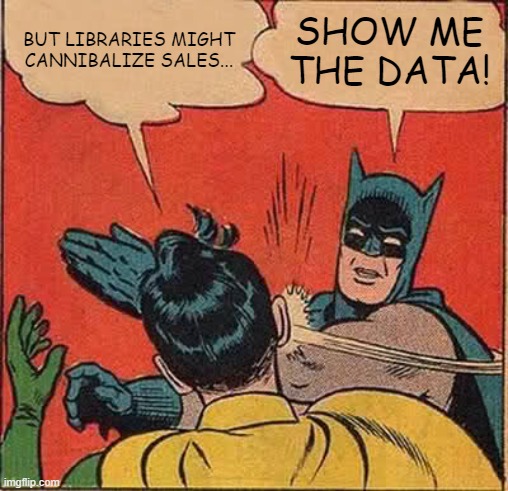
Since e-books were first introduced, authors and publishers have worried that the lack of “friction”—i.e. the need to go to the library to pick up a book—would lead to a surge in e-book lending at the expense of sales. According to survey results, the data suggests that is indeed happening: active library members were found to buy 42% fewer new books than non-members, and the substitution effect is strongest for the most popular, widely stocked authors.
I prefer PW‘s newsletter headline for Milliot’s article (“Changing Reader Habits Dent Author Incomes”) because it explicitly frames publishers’ anti-library pricing for ebooks as what it really is: anti-consumer.
Publishers have blamed libraries for cannibalizing consumer sales for years without offering any public proof, except for that one time Macmillan’s John Sargent surprisingly, and somewhat off-handedly, acknowledged the open secret that Amazon was providing whatever “proof” there was during an incredibly misguided AMA session at PLA in 2020. I was running the Panorama Project (RIP) at the time and was told by a few different executives at different companies that there was actually one specific scenario where the claim had some merit: perennial bestselling authors.
Specifically bestselling authors who historically sold a lot of expensive hardcovers, which have gotten more expensive over the years. Authors like, perhaps — as a potential example only — beloved indie bookstore and school library champion, James Patterson?
The Authors Guild loves anecdotal surveys that help them “prove” authors are being cheated in nefarious ways that don’t point back to publishers, and their latest one draws some interesting conclusions from an undefined pool of readers who “read at least one book in the last month and four books in the last year.” Including libraries with other “free” sources like friends, personal collections, and pirate sites is a subtle form of lying with data (aka, disinformation), and they continue their habit of following the AAP’s lead on attacking libraries whenever possible, even as their “data” continues to identify trade publishing’s core business model as the primary culprit.
With Patterson unexpectedly weighing in, too, the past two weeks feel like a disturbingly coordinated effort at a critical time when librarians are actively defending the freedom to read on multiple fronts, while also fighting for the funding that enables libraries’ very existence. I wonder what might have suddenly riled them all up?
At the risk of making myself even more unemployable in publishing than I already am, I won’t say any more, but I might have to put on my “occasional journalist” hat in Chicago later this month to dig into things a bit more. Again. Stay tuned…
__TWO
Who chooses your book, and who reads it? | Arthur Attwell
In commercial publishing, pleasing the selector is critical for getting the book sold. And pleasing the reader helps make the next sale, either by satisfying the original selector (‘My students passed my class’), or turning the reader into a champion (‘I want to read the sequel!’, ‘You should also read this!’).
When I was running the Panorama Project (RIP), I launched the Immersive Media & Reading research project, which included gathering a cross-industry coalition as an advisory board to weigh in on the development of both the methodology and survey itself, ensuring the final data held up to scrutiny — even if interpretation of the findings inevitably varied. Two key factors I pushed to make fundamental pillars of the survey’s development were a) recognition that people “engaged” with books in different ways (eg, buying, borrowing, gifting) so there had to more nuance beyond “reading”, and b) we had to include other media to provide important context.
Despite being delayed by the start of the pandemic, and my leaving before the final report was released, it was a successful initiative that should have been the beginning of more collaborative research projects, but instead became a narrower ALA initiative, and as a result, easier for publishers, in particular, to dismiss as they did prior library-centric research over the years.
Attwell does a great job here of illustrating the “engagement” approach with his “selector” and “reader” framing, a concept large corporate publishers continue to struggle with as their core business model is built around prioritizing the former, while relying on intermediaries to help them reach the latter. Of course, not all selectors are considered equal, which presumably explains publishers continuing to defy (and deny) “reader habits” (aka consumer preferences) by villainizing a specific group of selectors readers have always known and trusted more than publishers themselves.
Changing a deeply entrenched business model is never easy, but the writing has been on the wall for more than a decade now, and rather than partnering with libraries to help create the “viable consumer marketplace” they recognized was needed back in 2010, publishers have doubled down on treating them like [revenue-generating, reader-nurturing, free marketing-giving] pirates instead.
Make it make sense.
___THREE
Inimitable Product is the New “Make Great Content” | Rand Fishkin
Google’s future is no longer indexing the web and making information universally useful and available, it’s wholesale, intentional, unrepentant, unfettered-by-the-law theft: the great digital enclosure of publishing. They haven’t been shy about this, but they’ve never been as loud and proud as they are now. “We’re going to ruin the Internet,” is Google’s new rallying cry, though they’ll frame it as “AI search for the agentic era” (a meaningless jumble of words reminiscent of Andreesen-clueless autocomplete).
I’ve been following the parallel (and related) “zero-click marketing” and GEO conversations closely over the past year or two, and with Google officially declaring traditional search dead — by their own hands, mind you — publishers of all types are scrambling to figure out how to deal with the ongoing loss of organic search traffic, and presumably the increased costs for whatever paid search evolves into.
Smart publishers (and marketers) saw the writing on the wall and had already moved away from relying on lazy “data-driven” SEO games for scale and clicks, so I don’t really have a lot of sympathy for the laggards. They’re mostly the same organizations that chased “data-driven” social and video pivots, only to find the rug pulled from under them by the platforms who were feeding them the data, and were left renting access to audiences they often helped those platforms build and monetize. (AI is the same scenario on steroids, aka, “The Great Digital Ransacking“.)
Making “great content” is still a viable strategy, but context has always been a critical factor, and that’s what’s evolved over the years. The best case scenario is when that context is the product or service your content is helping to market is actually good and does something useful for specific people! Quality products, services, and content always have an easier time finding an audience, partly because that audience will organically market them for you in channels that are important to them, some of which you’ll never have to access to. (Cue the Cluetrain reference: “Markets are conversations.“)
Word of mouth is the most powerful form of marketing, and even with your favorite social network, chatbot, or AI agent du jour in the middle, great products still organically generate word of mouth recommendations. The fundamentals haven’t changed, and while the channels have multiplied and attention has fragmented, only bad products (and bad marketers following generic playbooks) need to rely on constantly evolving tricks.
____FOUR
It’s Always the Small Things | Daniel Ritzenthaler
Three times three times three equals twenty-seven. When people start feeling a size twenty-seven dysfunction, they look around for a size twenty-seven reason. They find a few size three reasons and ignore them because the math doesn’t work. They’re adding — not multiplying.
I jokingly told someone recently that “rabbit holes are my passion!”, but it wasn’t really a joke. When I get interested in something new, I start digging in and find myself traveling down various rabbit holes, some of which lead to intersections with other well-traveled rabbit holes.
Ritzenthaler is one example, combining my overlapping interest in systems thinking and confusion about design thinking (which came to a head last month), with my serendipitous exploration of blogs and old school word of mouth.
“3 x 3 x 3 = 27” triggered an immediate “fuck yeah!” response when I read it, while simultaneously triggering PTSD from the many, many meetings I’ve been in over the years with people who could only focus on the “size twenty-seven dysfunction”. Or the many, many myopic articles I’ve read that I wish I could unread. It’s also a perfect footnote for the three previous Things, giving this newsletter one of its rare, serendipitous thematic arcs!
Always follow the money. And always do the math.
_____FIVE
How City Kids Used to Play on the Streets of New York | Naaman Zhou and Martha Cooper
A lot of the photos seem less like kids at play and more like kids at scavenge. They make worlds out of bed frames, bottlecaps, and broken wood.
This is a great photo essay, and what it depicts is exactly how I grew up in the Bronx in the 70s. It wasn’t John Hughes or Stranger Things, although we did ride bikes everywhere. We played tag in abandoned lots and stickball on congested streets, and built our own toys out of whatever scraps we could find.
I had no idea how poor we were, nor how rough NYC actually was at the time, but whenever I see pictures like these, or read stories about NYC in the 70s and 80s, I don’t remember the poverty, just the childishly ignorant joy of making the best of what we had.
I wish I’d known about Cooper’s exhibit at The Bronx Documentary Center sooner because this is the last weekend, but I’m going to try and squeeze in a visit before it ends. If you’re in the area, you should, too!
______BONUS
Do you like email?
Sign up here to get my bi-weekly "newsletter" and/or receive every new blog post delivered right to your inbox. (Burner emails are fine. I get it!)
What does the Patterson article say? It’s behind a paywall
He basically parroted AAP’s misleading talking points, but this was arguably the most egregious one: “The bills currently pending in the Rhode Island General Assembly (H7606 and S2525) would force authors and their publishers to license digital books to libraries on whatever terms the state decides, handing state governments unprecedented power over how authors distribute their work and undermining how authors are compensated for their creative contributions.” The bills don’t give states any power over anything; they simply call for requiring transparent negotiations when spending taxpayer funds is involved. Major publishers want to freely gouge libraries on ebook licensing as a way to create friction in the market, and prioritize their preferred retail channels and print formats.