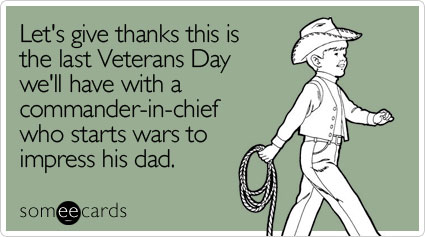
Veteran’s Day
In this light, it’s arguably one of the better Veteran’s Days in many years. Certainly the best card I’ve ever received!
More from someecards below the fold, and also on Facebook.
Commentary and advice on marketing, mostly for publishers (traditional and brands) and writers, but sometimes from a broader perspective.
In this light, it’s arguably one of the better Veteran’s Days in many years. Certainly the best card I’ve ever received!
More from someecards below the fold, and also on Facebook.
Just do it.
Or, as Gandhi put it, “Be the change you wish to see in the world.”
That, in a nutshell, is the primary message of Tribes: We Need You to Lead Us, Seth Godin’s masterful mini-manifesto on what it takes to be a leader and why YOU should be the one to take the lead.
“I can tell you this: leaders have nothing in common.
They don’t share gender or income level or geography. There’s no gene, no schooling, no parentage, no profession. In other words, leaders aren’t born. I’m sure of it.
Actually, they do have one thing in common. Every tribe leader I’ve ever met shares one thing: the decision to lead.”
Emphasis mine, but it’s a point Godin returns to several times throughout the book, illustrating it with numerous examples of people from various walks of modern life who didn’t take no for an answer: they rejected the status quo, risked failure to achieve success by being deeply committed to what they believed in, attracted like-minded people to their cause as a result, and led them forward.
“All you need to do is motivate people who choose to follow you…
This leads to an interesting thought: you get to choose the tribe you will lead.
Through your actions as a leader, you attract a tribe that wants to follow you. That tribe has a worldview that matches the message you’re sending.”
Through the wide range of instructive and/or inspirational examples he cites, from the requisite Steve Jobs and Starbucks, to the far more interesting Grateful Dead and Nathan Winograd — he even throws in a nod to Barack Obama, although unnamed, in a brief section sub-titled “Criticizing Hope is Easy” — Godin gets in front of almost every likely objection someone might have for why his premise doesn’t apply to them and knocks them down.
The odds are pretty slim, and not just because they’re on the verge of going out of business:
“I market books for a living, so I can tell you an unpleasant truth: the order for any book, from any account, starts at zero,” [Andrew Wheeler, a marketing manager at Wiley] warns. “The publisher’s sales rep walks in the door with tipsheets and covers, past sales figures and promotional plans, to convince that bookseller’s buyer to buy that book… Sometimes, that buyer is not convinced, and the order stays at zero.”
(h/t GalleyCat)
The distribution system in publishing is arguably broken, partly a result of the industry’s major players’ short-term thinking, and partly because the overwhelming number of books being published these days is more than the system can support.
(Writer’s Digest publishes an aptly titled book: Some Writers Deserve to Starve! Think about it.)
[youtube:http://www.youtube.com/watch?v=v5SWQJWm6Tg] "And I got my middle name from somebody who obviously didn't think I'd ever run for President." I just got around to watching Obama's speech at the Al Smith Dinner the other night and it's funny as hell, taking shots at McCain, Clinton, Schumer, Bloomberg, Giuliani, Wall Street and, most importantly, himself, showing a sense of humor that has rarely been on display during the campaign or in the majority of SNL's political skits.
Buried in a glowing American Journalism Review article about the success of The Politico -- a politics-only news website that launched a couple of years ago and is getting 25 million page views/month -- is the fact that 60% of its revenue comes from its laser-targeted, thrice-weekly 27,000 circ print edition, without which, the site would "be losing catastrophic amounts of money." THE PLIGHT OF POLITICO -- AND EVERYONE ELSE. The success of Politico actually seems like an incredibly discouraging sign for the media. Here you have this forward-thinking, primarily virtual venture to create a political news organization that marries…
I was only able to make it to one session at Thrillerfest yesterday, but it was one I had a particular interest in as it focused on book marketing, a huge black hole in the industry as the minuscule budgets publishers set aside for it are invariably dedicated to the can’t miss A-list authors while the mid-list and debut authors receive little if any support at all. And that’s for commercial fiction; it’s even worse for literary fiction and poetry, never mind comic books.
M.J. Rose and Doug Clegg have their “Buzz Your Book” format down cold and after a brief introduction that noted how they both got lucky (translation: opportunity met preparation) with what they did for their own books, they explained that, while their successes aren’t necessarily duplicable, they do offer a fundamental model that any author can follow up on. Instead of prattling on in generalities, or offering examples of ideas that can’t be duplicated, they called on volunteers to pitch their own books and then offered specific ideas for them to market them effectively and interestingly.
Sadly, none of the ideas included traditional advertising in writing magazines!
Thrillerfest kicked off yesterday at the Grand Hyatt Hotel here in New York and I had the pleasure of attending the full day — I’ll be back tonight and most of Saturday — meeting some great people, picking up some interesting books, and taking in some insightful information on the publishing game from the perspective of successful authors in the thriller genre. Prior to attending, I considered myself a fan of thrillers but quickly realized the genre I tend to enjoy most is classified more as mystery than thriller — marketing semantics that, according to several authors, means more money for the thriller genre — the difference being the former’s focus on figuring out what happened while the latter emphasizes something that’s going to happen and the clock is ticking.
Lawrence Block’s Scudder series, my hands-down genre favorite, definitely falls under crime mystery, while Charlie Huston’s Thompson and Greg Rucka’s Kodiak series are thrillers, though neither author is in attendance at the show nor represented in the Barnes & Noble bookstore on-site, presumably because neither is a member of the sponsoring organization, International Thriller Writers. Inspired by the energy of the conference, I picked up four novels by authors I’ve never read before, including Kathleen Antrim (pictured, right), Steve Berry, Andrew Gross and David Liss, all but the latter I saw or met yesterday. I’ve started reading Antrim’s Capital Offense, which she describes as “What if the First Lady was plotting to kill the President?” and so far, it’s a brisk read that hits all the right notes expected from the genre.
The first session of the day, Learn How to Pitch Your Book (conducted by Antrim & Bob Mayer), was particularly fascinating for its breakdown of the process of developing a 25-word summary of your book that serves not just as your pitch to agents and editors — the only two influential people who will have actually read your entire book before it hits the bookshelves — but when done well, will represent it all the way through the sales process, internally and externally.